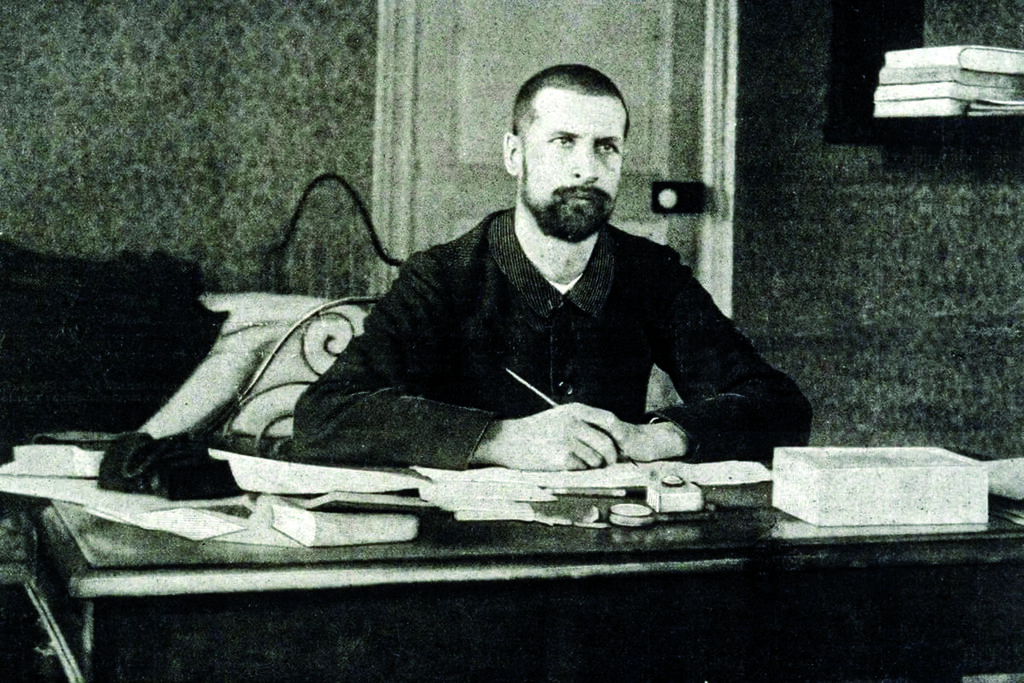
This is not a biography, nor a detailed catalog of Dr. Alexandre Yersin’s scientific or personal accomplishments. There are numerous more competent and complete recitations available than I am putting forward; Wikipedia for one. This is the story of how one man chose the unobvious life path and fell in love with Vietnam, saved thousands of lives in the process, and created the scientific infrastructure in the country that lasts to today. He gave away his professorships, salaries, scientific awards, social prestige, and colonial comforts to be at-scale useful to the average person. His diaries tell us he was happiest treating the Nha Trang fishing families in his free clinic that he cleverly funded by selling rubber tree sap to the Michelin tire company. From his wooden house in Nha Trang he localized the production of life-saving quinine, discovered and built the hill station of Dalat, identified the bacterial cause of the plague and its first effective treatment that he cultivated in the blood of his yard animals, founded the first medical schools, negotiated peace treaties between warring hill tribes, built Vietnam’s first weather station to warn fishermen of storms, and still found time to host community screenings of Charlie Chaplin films. He accomplished most of this before the age of 40. Yersin is one of the most widely recognizable foreigners among modern Vietnamese, but his contribution to the country is less known beyond its borders; thus this blog. Enjoy!
Historical sidebar: last flight out of Paris
We begin our story of Yersin’s life near its end. In May 1940, Yersin is 76 years old and waiting to depart on what is likely the last commercial flight out of Paris bound for Indochina before Le Bourget airport is captured by the approaching Nazi forces. He is departing for Saigon, which itself will come under Japanese occupation within months. By this point he is in poor health and the five-day journey will be arduous, but his sole concern is returning to the country and people with whom he has spent the past 50 years. Yersin will live only two more years after this scene. (for a dramatic retelling of this scene, see Patrick Deville’s book “Plague and Cholera”)
Early Life in Switzerland
Alexandre Yersin was born the youngest of three children in 1863 in French-speaking Aubonne, Switzerland three weeks after his father died of a cerebral hemorrhage. Yersin and his siblings grew up under their mother’s care helping her run a girls’ school in the nearby lakeside town of Morges.
By 1885 at 22, he had demonstrated strong academic talent and was sent to Paris to finish his medical degree at the Hôtel-Dieu hospital. The following year, Émile Roux invited him to join Louis Pasteur’s prestigious laboratory at the École Normale Supérieure. Here Yersin assisted in refining the anti-rabies vaccine, a procedure he would later collaborate on with Albert Calmette in Saigon to manufacture at scale. This process involved attenuating the rabies virus through successive passes through the rabbit’s spinal cord to create a vaccine safe enough for human use. While autopsying a rabid rabbit, he accidentally cut himself and likely contracted the virus, requiring his own vaccine to save his life.
In 1888, Yersin defended his doctoral thesis titled “Étude sur le Développement du Tubercule Expérimental” (Study on the Development of Experimental Tubercle) where he demonstrated induced tuberculosis in rabbits through intravenous injection of bacilli, leading to a rapid septicemic form of the disease that differed from typical pulmonary tuberculosis. This proved that tuberculosis wasn’t exclusively a lung condition, and could manifest in other forms. He termed this “typhus bacillosis” and highlighted its distinct pathology, including widespread organ involvement without the usual tubercles. (for a tuberculosis deep-dive, click HERE)
At 26 he was a practicing physician, a French citizen, and a researcher at the newly opened Institut Pasteur (Pasteur Institute). The institute was funded through public donations two years prior in 1887 after Pasteur’s rabies vaccine success, and quickly grew into Europe’s premier center for microbiology and infectious disease research. At the institute, Yersin isolated the toxin produced by the diphtheria bacillus, Corynebacterium diphtheriae, by growing the bacteria in nutrient broth, filtering out the cells using porcelain strainers, and injecting the sterile filtrate into host animals, in his case guinea pigs and the ever-present rabbits. The animals quickly developed diphtheria’s hallmark symptoms of throat membrane formation and heart damage. This experiment proved the toxin alone caused the illness and, by logical extension, detailed a potential antidote. Through trial-and-error Yersin and Roux developed a methodology to hyperimmunize horses with the toxin, and extract antitoxin-rich serum from the horse’s blood. Later in life, he would again adapt this process to incubate plague serum in his own Nha Trang livestock.
Ship’s Doctor (age 26)
By 1890 the Compagnie des Messageries Maritimes needed a ship’s doctor for the long Marseille to Saigon run. Louis Pasteur himself, after surely attempting to dissuade Yersin from giving up a promising science career, personally recommended him for the massive demotion. At 26, he left a position at arguably the most prestigious research institute on earth to join the crew of a steam ship, for seemingly no other reason than he wanted to.
He began his new career on the Saigon to Manila line of the SS Volga, and later on the SS Saigon between the colonial port towns of Saigon and Haiphong. The job gave him weeks at sea with nothing to do when not treating the random sailor but study navigation, explore intellectual curiosities, and teach himself Vietnamese.
By July of 1891 he had his fill of the sea, resigned, walked ashore in the town of Nha Trang, bought a plot of land, and began building a small wooden house. By year’s end he had completed his house and clinic and became one of the town’s first western doctors, and surely the only one to offer his services free of charge to locals.
First Years in Nha Trang (1891–1892, age 27–29)
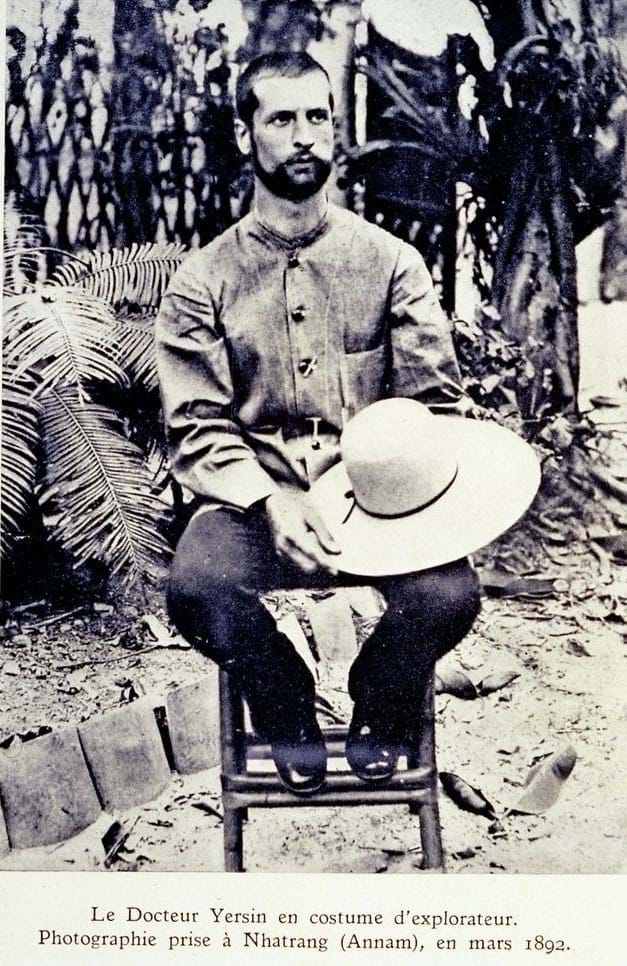
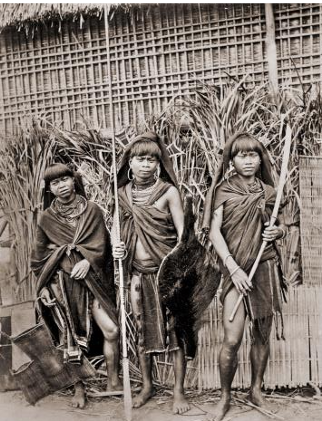
After arriving in Nha Trang he chose to live among the fishermen rather than in the French quarters and largely eschewed colonial life and the trappings to which many Europeans had grown accustomed. At the time Nha Trang was still a small, quiet fishing village on a sunny bay backed by jungle-clad hills populated by the K’Ho (also known as Lach and Chil) people and other highland ethnic minorities. He settled in the quiet riverside neighborhood of Xom Con, built a simple wooden house with his own hands, and opened his free clinic. In short order he learned fluent Vietnamese and began deciphering the dialects of the highland ethnic minorities, becoming useful as both doctor and occasional tribal mediator.
The Great Expeditions (1891–1894, age 27–31)
First Scouting Trip (late 1891)
Yersin made his first meaningful push inland from Nha Trang late in 1891. He rode south on horseback along the coast through Phan Ri and Phan Thiet before hiring a local guide to strike out west-southwest into the forest toward the Di Linh plateau and its nearly 4,000-foot pass. The journey introduced him to steep passes, rainforests thick with leeches, sweltering heat that could reach 100 degrees daily, torrential rains, and the malaria that would follow him for the rest of his life. Although the guide refused to continue because of a lost-to-history expression of danger and he never reached Saigon, the abbreviated journey showed him that the unexplored reaches of the country’s interior could be navigated and were worth further investigation.
The Crossing to the Mekong (September–December 1892)
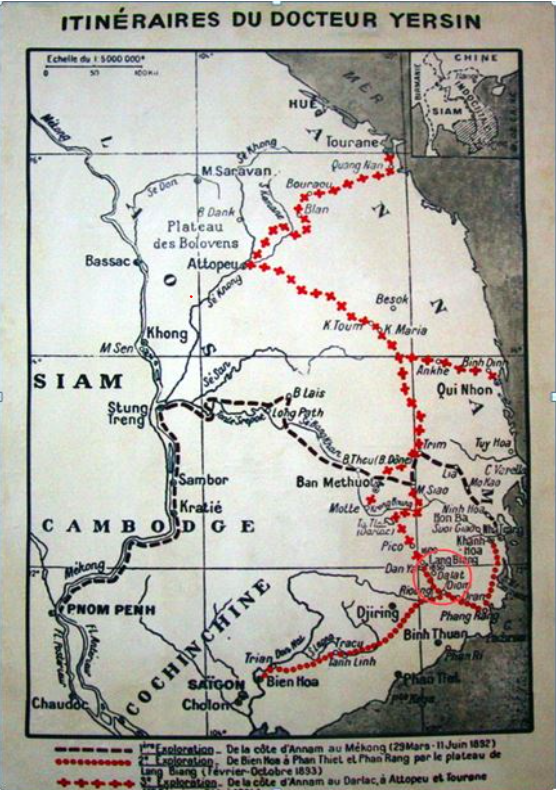
A year later in September 1892 Yersin launched a much larger expedition. He set out with seven men, horses, and two elephants and headed west-northwest from Nha Trang on a route that covered roughly 250 miles through Ninh Hoa to Buon Ma Thuot and then farther west until they reached the Mekong River at Stung Treng in present-day Cambodia. He completed the return leg by canoe through Phnom Penh. Over the nearly three months of the journey, he produced the first accurate European maps of that section of the mountains, recorded observations on the highland tribes, and took more than 140 photographs before sending the maps to Auguste Pavie’s geographic mission. The crossing proved that reliable land routes existed between the coast and the Mekong.
The Discovery of Lang Biang and the Grand Circuit (1893–1894)
In the late nineteenth century, European officials in Indochina fell ill at an alarming rate. Malaria, dysentery, and cholera made lowland service especially dangerous, particularly for unacclimatized new arrivals. Epidemics were not rare. Vietnamese and French records from the preceding century document more than a hundred outbreaks and epidemics between 1800 and 1880. The French army documented that during the Tonkin campaign of 1885, they lost more men to cholera than to combat. Treatment at the time was limited, and the conditions of recovery unsanitary. The British had already addressed this problem in India by building hill stations in the mountains, but the French in Indochina did not yet have an equivalent. The ranges inland suggested that a suitable location might exist, but the topography of the interior remained poorly known.
In 1893, Jean-Marie de Lanessan ordered Alexandre Yersin to cross the interior between southern Annam and Laos and report what was there.
Yersin left Nha Trang and went south to Bien Hoa, where he assembled a caravan for inland travel. The group included roughly 80 porters and several elephants to carry instruments, provisions, and trade goods.
From Bien Hoa, Yersin moved inland along the upper basin of the Dong Nai River, following existing tracks through its tributaries and valleys. The route climbed gradually through what is now Dong Nai Province toward the highlands around Bao Loc and Di Linh. As elevation increased, dense lowland forest gave way to pine, and then to the grass-covered plateau.
They reached the Di Linh plateau at around 4,000 feet. The temperature dropped, and the tropical-latitude air changed to resemble something more similar to that of Yersin’s Swiss upbringing. The team rested in the lower areas of the alpine grasslands, before pressing higher towards what they identified as a pass into a new valley.
On June 21, 1893, approaching from the southeast, Yersin passed near the Prenn falls and emerged from an alpine pine forest onto the grassy expanse of the Lang Biang Plateau. He described it in his diary that day as a “an immense plateau like a sea of green waves.”
Yersin and his party spent the night in the village of Dankia, where he recorded the dramatic shift in weather and documented the hill tribe residents before pressing higher the next morning.
The expedition continued north through what is now Dak Lak, crossed into southern Laos near Attopeu, and followed river systems eastward, reaching the coast at Da Nang on May 7, 1894. Over the course of the journey, Yersin mapped large sections of the interior, recording river courses, settlement patterns, and the language classifications of the highland communities he encountered. The work extended beyond the initial objective of locating a suitable upland site and produced the first continuous traverses of the region from the southeast coast to central Annam.
Several years later, Dr. Émile Tardif conducted a more detailed hygienic survey of the plateau and recommended a nearby site that was slightly lower, drier, gently sloped, and suitability for construction. This site was later named Dalat.
Hong Kong and the Plague (1894, age 31)
In May 1894 an outbreak of bubonic plague reached Hong Kong and spread rapidly through the crowded districts of the colony. Mortality was high and the cause of the disease was still not yet clearly established. Leading scientific powers dispatched their top teams to finally establish a cause, and the French government sent Yersin from Indochina to carry the investigation flag.
He arrived in June to a less-than-warm welcome from the competing teams that had already occupied the limited research space. What space was available, was controlled by the British colonial authorities and already largely reserved for other researchers before his arrival, including a Japanese team led by Dr. Kitasato Shibasaburō. As a result, Yersin was given no formal laboratory, and instead worked in a makeshift bamboo hut near the Government Civil Hospital in the Sai Ying Pun district. The site is now occupied by the Sai Ying Pun Jockey Club Polyclinic.
Yersin only had access to the simple equipment he brought with him, and almost no access to living patients. Since he could not study the ill (still alive), he shifted his attention to the macabre consequences of infection; cadavers with swollen lymph nodes, or buboes. By aspirating fluid directly from these lesions, he identified a short bacillus present in large numbers within the diseased tissue, but not present in healthy tissue.
He extended the observation to the dead animals found near the infected, and arrived at similar results. The same bacillus was present in rats, suggesting a likely infection vector.
Kitasato’s team published quickly, but their cultures produced inconsistent results. Ironically, we now know that the bacteria that causes plague prefers cold, so Yersin’s unheated bamboo hut was a blessing in disguise, when compared to the relative luxury afforded to the Japanese team. In the final publications, Yersin was awarded full credit for discovering plague bacillus, later named Yersinia pestis.
Return to Nha Trang (1894–1895, age 31–32)
After completing his work in Hong Kong, Yersin left the colony and returned to his little wooden house and public clinic in Nha Trang as quickly as passage could be arranged. The Pasteur Institute and his former colleagues urged him to return to Europe, or at least take a role more fitting of his new-found fame in one of Asia’s booming colonial capitals, but he refused and departed for Xom Con stating years later in an interview “I have my whole life here, in Nha Trang…”.
Back in Nha Trang, he set to work adapting a method he developed earlier at the Pasteur Institute to produce anti-plague serum locally with the limited equipment on hand. The horses he kept in his yard for inland exploration were inoculated and repurposed as antibody generators. 6 liters of blood were drawn from each horse every 2 to 3 weeks yielding enough functional anti-plague serum to treat approximately 10 patients. The process was time-consuming, labor-intensive, and tiny in scale compared to the magnitude of outbreaks, but by the end of 1895, the pack horses had become Indochina’s first microbiology laboratory and production facility.
Through the end of that year, production remained limited by Nha Trang’s relatively modest horse population, but what could be produced was shipped to the ongoing outbreaks in Hong Kong that had metastasized to southern China, and to the Bombay epidemic that flared the following year in 1896.
Pasteur Institute and Applied Sciences in Nha Trang (1896–1905, age 32–42)
In 1896 the horse-yard laboratory that had supplied Hong Kong grew into a formal institute. Yersin secured support from Paris but opted to keep the operation in Nha Trang. He continued to use the same animals, the same method of inoculation and bleeding, and the same small-batch, labor-intensive processing. As he expanded the herd and refined the procedure, output increased from tens to hundreds of treatment doses per month, exported across Asia. By year’s end, Yersin’s newly formed institute was the dominant supplier of plague medication in Asia.
After his serum-herd was stable, he turned his attention to agriculture and medicinal crops that could be cultivated in the tropics of Nha Trang and the cooler climes of the recently-discovered Lang Biang plateau. At sea level, rubber trees were planted and replanted until they held in the hot and sandy local conditions. The mature plants eventually produced latex which Yersin sold to the Michelin tire company. The revenue from this arrangement was the primary source of income for his free clinic. These trees were the first successfully planted in Vietnam, and the ancestors of the country’s multi-billion-dollar rubber export business.
At higher elevations he hired indigenous tribes to help him cultivate cinchona to provide a domestic source of quinine. This horticultural effort was also successful, though at a smaller scale. As cultivation expanded, a two-story house was built on the site to serve as a high-altitude research and weather station. The small wooden house and the cinchona cultivation land remain to this day as the Hon Ba Nature Reserve.
By the 1920s, Yersin controlled nearly 5,000 acres of central Vietnam across his plantations, hyperimmunized herds, and horticultural experiments. Herd counts peaked at more than 2,000 animals that produced more than a half million annual doses that were exported across Asia, making Nha Trang the largest such producer in Southeast Asia at the time.
Lasting Infrastructure and legacy
In the early years of the 20th century, Yersin focused his attention on expanding cinchona cultivation and quinine production, and founding the École de Médecine de l’Indochine (Indochina Medical College), now known as the Hanoi Medical University (HMU) and the Hanoi University of Pharmacy (HUP). He served as the inaugural director for two years, before returning to Nha Trang in 1904.
Aside from the occasional expedition, Yersin spent the rest of his life in his wood-framed house in Xom Con near Nha Trang. The house was part home, part clinic, part workshop, and part cabinet of curiosities. It collected telescopes, barometers, clocks, imported medical equipment, and devices he had modified or built himself. Among his most prized possessions were some of the first cameras in the region, which he used to record the daily life of the village around him.
For many families along the coast, his home-clinic was the only reliable source of Western medicine within reach. The ground floor filled each day with fishing families seeking treatment, advice, and medicine. Yersin never charged a patient for a consultation or the drugs dispensed. Some supplies he sourced from his own farms around Nha Trang or his higher-altitude stations on the plateau. What he could not produce himself, he ordered through French suppliers or directly from the Pasteur Institute in Paris, all paid for through the proceeds of his rubber tree plantation.
In the evenings after medical rounds, Yersin sometimes turned his yard into an outdoor cinema, projecting Charlie Chaplin films onto a bedsheet for local families. Some nights, he gave astronomy lessons to local children with one of the few telescopes in Indochina. During the day, when not treating patients, he kept detailed meteorological records, tracked barometric pressure, and warned fishermen when he believed a major storm was coming. This record keeping, combined with the high-altitude Hon Ba station observations together formed one of Vietnam’s first formal weather tracking system.
Remembering Ong Nam
On March 1, 1943, Alexandre Yersin died of self-diagnosed myocarditis. Before his death, he left instructions stating that he wanted to be buried on his Suoi Dau property with a view of the sea, and that all his accumulated assets, including thousands of acres of land, would pass to the Pasteur Institute of Nha Trang. In his will, he went on to state that he wanted a simple funeral, “sans aucun apparat ni discours,” without any pomp or speeches, a request the local residents of Nha Trang thoroughly ignored. When news of his passing spread, K’Ho and Lạch from the Lang Biang plateau and Raglai from the mountains west of Khanh Hoa descended to join the masses paying their respects. Tribesmen, French dignitaries, mandarins, and fishermen formed a funeral procession that stretched, by some accounts, more than two miles, following him to his final resting place to pay respects to the man locally known as Ông Năm, the Fifth Uncle.
Following Yersin’s death, decades of war, revolution, and the rise of communism methodically renamed most colonial-era streets and landmarks across the newly unified country, with a few notable exceptions: Pasteur, Calmette, and Yersin. Numerous schools, universities, hospitals, clinics, and research institutes have since been named after him. The Pasteur Institute network continues its public health work to this day, with major operations in Saigon, Hanoi, Dalat, and, of course, Nha Trang, where Yersin’s original two-story wood-framed home-clinic still stands inside the institute’s compound and remains open to the public.