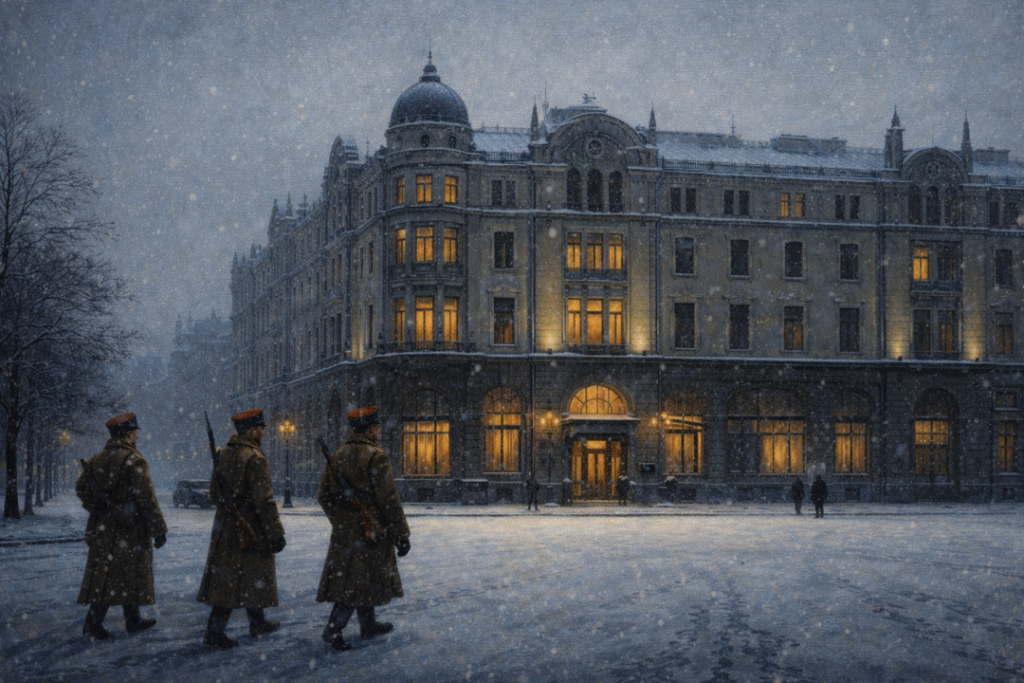
By the early 1920s, when A Gentleman in Moscow is set, the aftermath of the Russian Revolution and the civil conflict that followed had already reordered daily life. Property was confiscated, social rank became a liability, and those who once commanded respect through status learned to speak carefully or fade from view. Despite the upheaval beneath Russian society, Moscow could still appear, at a glance, much like the old capital. Streets remained busy, cafés stayed open, and hotels continued to operate much as they always had, even as the risks attached to ordinary routines multiplied for those tied to the former order. The novel begins at this moment, with its protagonist spared execution and sentenced instead to lifelong confinement inside a single luxury hotel, while nearly everything that had given his life meaning was dismantled beyond its walls. Set within the early rise of Soviet power, the book stays with a man trapped in a gilded cage as that new order erases the world he once knew.
Confined to the Hotel Metropol, Rostov recognizes that whatever remains of his former life will survive only if it is actively maintained. He understands that order, once abandoned, does not return on its own. He concerns himself with how his room is kept, how he dresses, how meals are taken, and how conversations are conducted. These are not gestures of nostalgia, nor are they symbolic acts. They are practical decisions made within a world that has sharply reduced his room for action. The hotel provides a setting where such decisions still matter. It has its own routines, hierarchies, and expectations, largely insulated from the volatility beyond its doors. Within that contained environment, Rostov is able to preserve a degree of order in his days, even as the larger social order dissolves. As Towles observes, “If a man does not master his circumstances, then he is bound to be mastered by them.” Rostov’s circumstances are limited, but they are not empty. Even in “the smallest room that he had occupied in his life,” the world, as the novel notes, “had come and gone.”
“It was, without question, the smallest room that he had occupied in his life; yet somehow, within those four walls the world had come and gone.”
What makes A Gentleman in Moscow worth reading is not its historical setting or its charm, but its attention to what remains possible when larger control is lost. Rostov does not believe that his behavior will alter the direction of events or protect him from their consequences. He recognizes early that much of what once structured his life is gone and will not return. What remains is a narrow field of action, how he conducts himself, how he treats others, and how carefully he maintains the routines that still exist. These choices are small but cumulative, and the novel allows them to unfold slowly. The proactive act of maintaining dignity, when that is all one has left, is the point of the book. Order exists only where it is actively maintained, and it fades away when those tasked with its maintenance stop caring.